ReSQue

Representative Surrogate Query for
Streaming Video KV Cache Compression

1KAIST    2NVIDIA

Same video, same question (Qwen2.5-VL-7B, LongVideoBench, a 19-minute video). Full KV prefills the whole video, 52K tokens, after the question is asked. InfiniPot-V and ReSQue process the stream with a fixed cache of about 6.5K tokens. ReSQue answers correctly like Full KV, while InfiniPot-V answers incorrectly.

TL;DR
We present ReSQue (Representative Surrogate Query), which learns a few reusable query vectors per attention head by matching the attention that future questions pay to the video. A single matrix product with these fixed queries scores the streaming KV cache — no extra forward pass — so it is more accurate than prior compressors at nearly the speed of a sliding window.
Streaming video understanding requires multimodal large language models (MLLMs) to compress growing KV caches before future questions are known, risking the loss of relevant information. We introduce ReSQue (Representative Surrogate Query), which directly learns reusable queries to preserve information needed by future questions. We define oracle attention as the attention averaged over possible future questions, whose highest-scoring tokens maximize expected attention retention for a fixed cache. Since this oracle is unavailable, ReSQue constructs target attention by averaging question attention for each calibration video and directly optimizes head-level query vectors to match its distribution. Once learned, these queries are reused across videos and compression rounds, scoring cached keys without additional model or scorer-network forward passes. We evaluate ReSQue on three MLLM backbones and four video QA benchmarks. ReSQue achieves the best or tied-best accuracy in 25 of 27 long-video settings. Further analyses demonstrate closer alignment with future-question attention and efficient streaming compression with low recurring computational overhead.

Overview

In streaming video, the KV cache must be compressed before any question arrives. If the future questions were known, we would keep the visual tokens that they attend to most. ReSQue approximates this ideal with a small set of learned, fixed query vectors per attention head: they are fitted once per model and then reused for every video and every compression round.
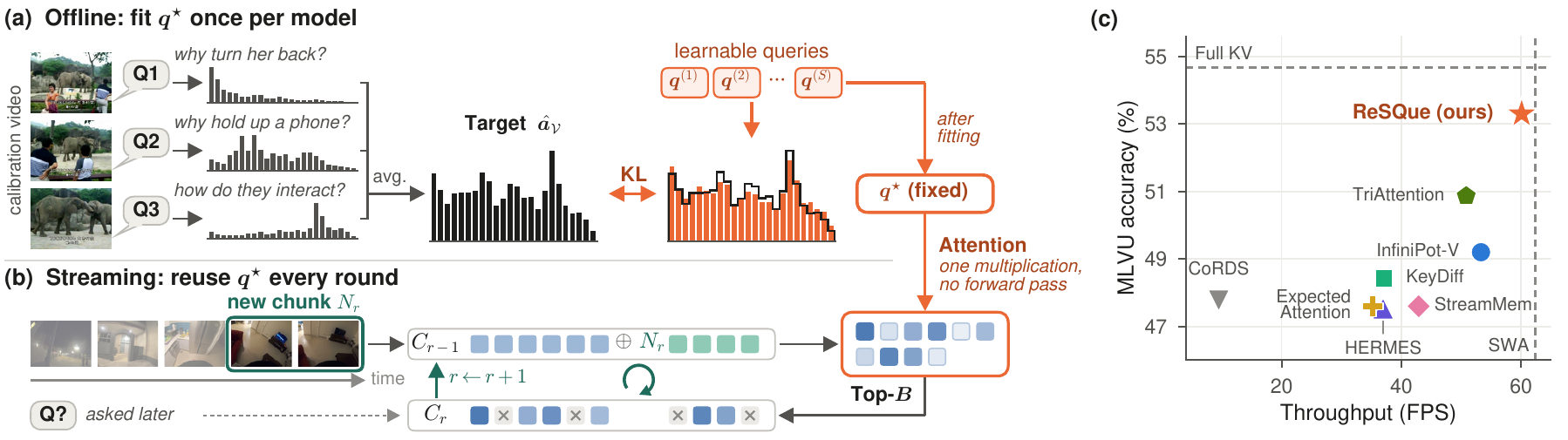
Overview of ReSQue
(a) ReSQue fits a few queries per attention head so that their attention matches the question-averaged attention on calibration videos. (b) During the stream, the fitted query is reused at every compression round and scores the cache without a forward pass. (c) MLVU accuracy at 6K against throughput (frames per second), averaged over three backbones.

1. Oracle attention

Averaging the attention of all future questions over the cached visual tokens gives the oracle attention. Keeping its highest-scoring tokens maximizes the expected attention retained by a fixed-size cache.

2. Fit queries to the target attention

The oracle is unknown, so we build a target attention per calibration video by averaging the attention of its questions, and optimize S = 8 query vectors per head to match that distribution with a KL divergence. The fit takes under two hours on one GPU.

3. Reuse during streaming

At every round the fixed queries score the cached keys with one batched matrix product — no model or scorer-network forward pass — and each KV head keeps its top-B tokens.
Quantitative Results

Under the same budget of about 6K, 3K and 1K visual tokens per head, ReSQue achieves the best or tied-best accuracy in 25 of the 27 long-video settings of three backbones, three benchmarks and three budgets. Its overall accuracy leads the strongest baseline, TriAttention, by 0.4 to 3.0 points, and at 6K it matches the uncompressed model on Qwen2.5-VL.

25 / 27
long-video settings with the best or tied-best accuracy
58–65
frames per second, about 96% of a sliding window (SWA)
0.11 s
to the first token at every stream length (Full KV: 1.0–12.8 s)
< 2 h
to fit the queries once per model on one GPU

Accuracy (%) at 6K / 3K / 1K visual tokens per head. MLVU: average over task groups; Video-MME: medium and long videos; LongVideoBench: average over the four video-length groups; Overall: mean of the three. Bold: best, underline: second best (Full KV excluded).

Efficiency

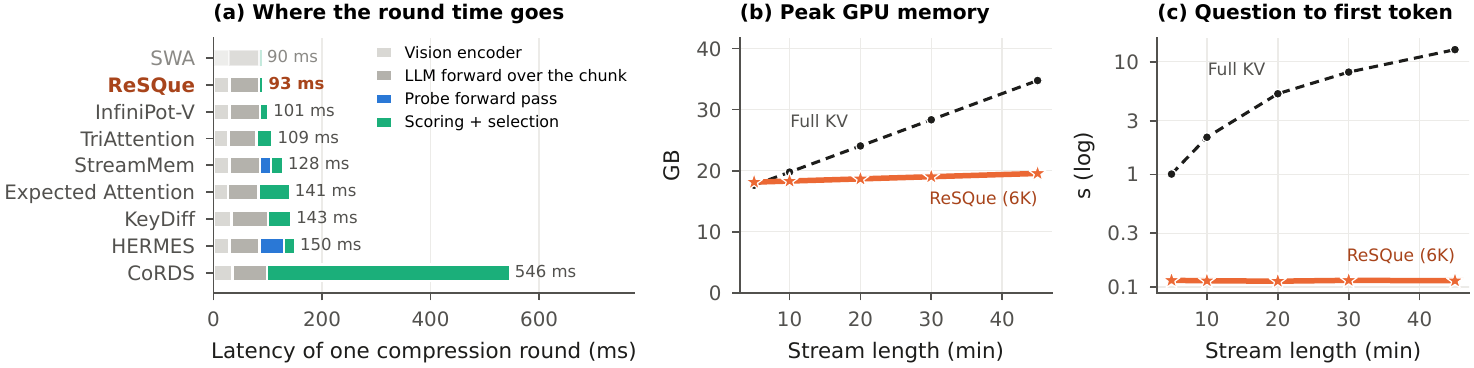
Because the queries are fixed, scoring needs no forward pass: a compression round of ReSQue is close to that of SWA, which scores nothing, while it is 1.1–5.9× faster than the other compressors on Qwen2.5-VL.

Frames processed per second at 6K (6-frame rounds) —
Every method is timed with 6-frame chunks (HERMES keeps its 16-frame chunks for accuracy but is timed with 6 frames here). Hover a bar for the round latency.
Cost of streaming compression
Cost of streaming compression on Qwen2.5-VL (Video-MME videos of at least 45 minutes, one RTX PRO 6000). (a) Latency of one compression round on a 6-frame chunk at 6K. (b) Peak GPU memory and (c) time from the question to the first token, as the stream grows. Full KV prefills the whole stream after the question.

Streaming Benchmark: VStream-QA

When questions arrive while the stream is playing, ReSQue is the most accurate over all questions on Qwen2.5-VL and LLaVA-OV, and ties TriAttention on Qwen3-VL.

Accuracy (%) at about 6K tokens per head on the ego-centric (Ego) and movie (Mov.) splits and on all questions; open-ended answers are judged by an LLM (gpt-5-mini).

Qualitative Examples

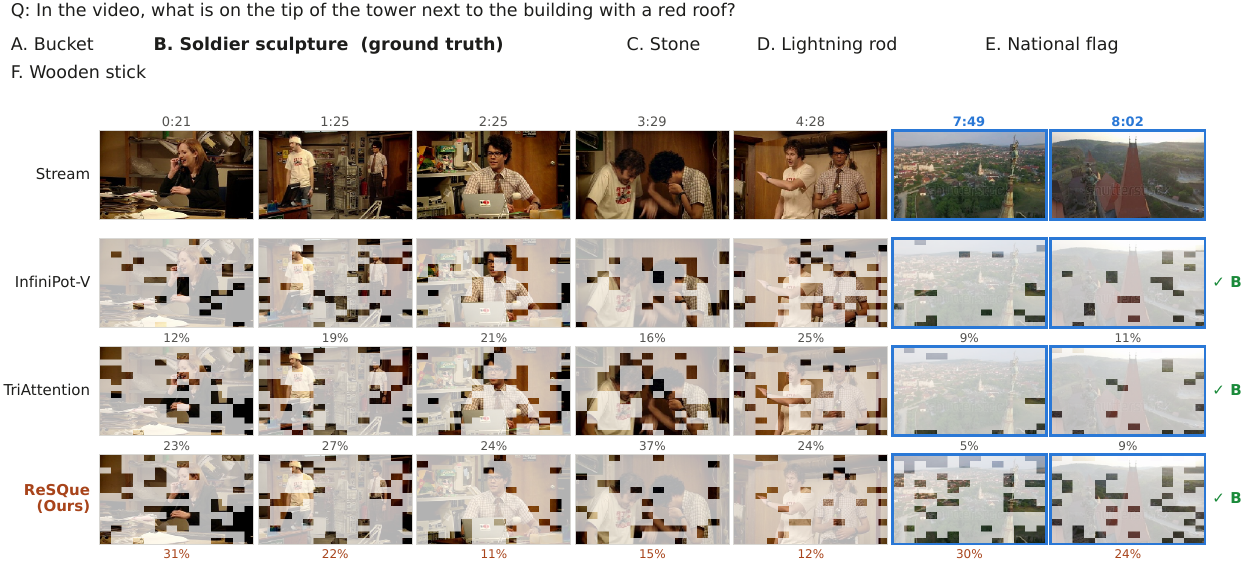
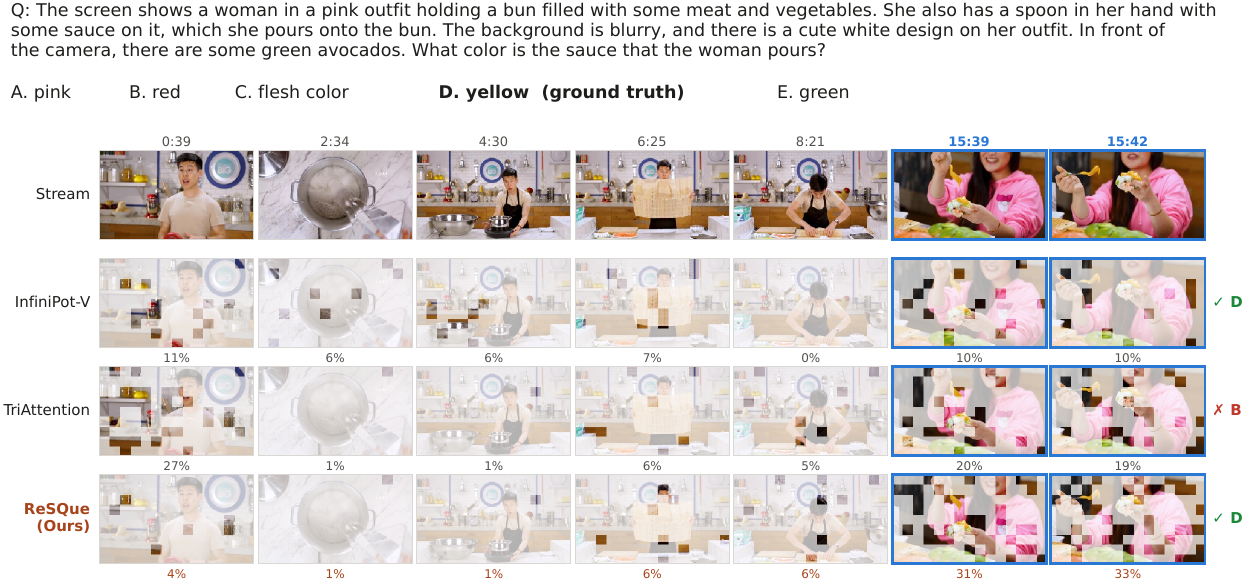
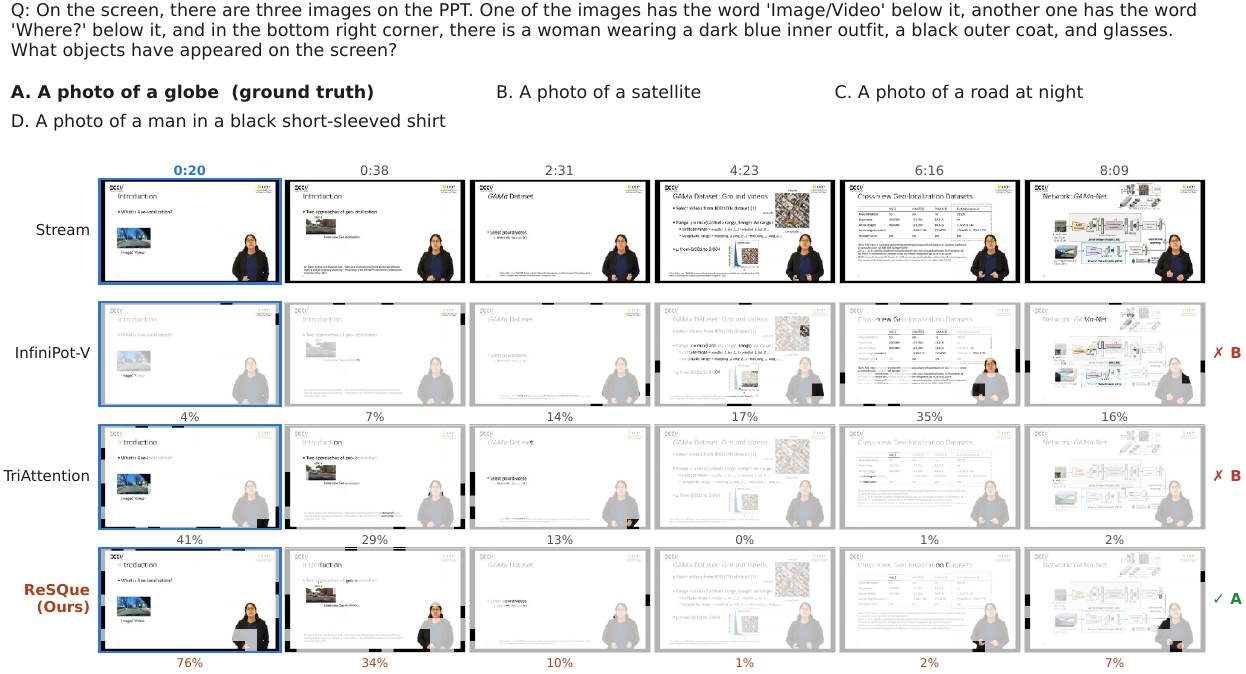
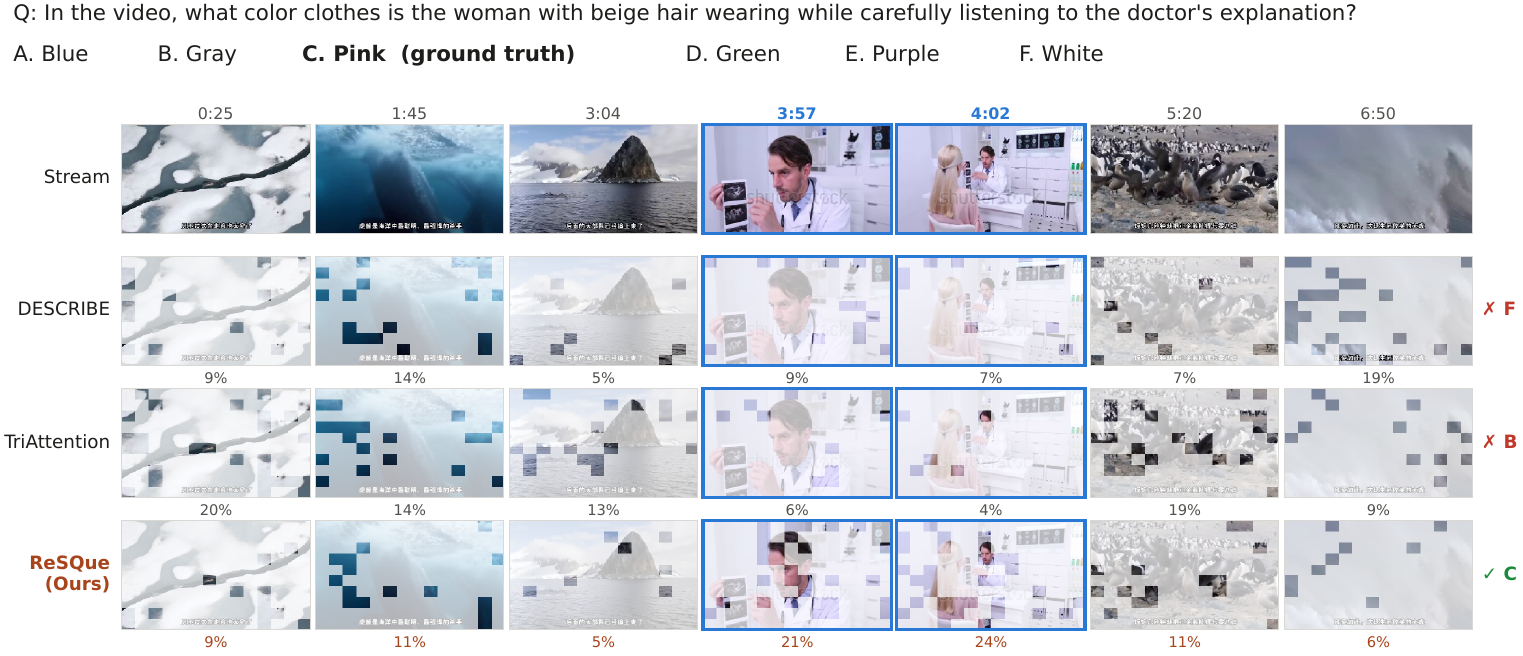
We draw the patches that each query keeps in one head when the question arrives. ReSQue keeps more of the evidence frames (blue) that the question actually reads.

Qualitative example, MLVU Qwen3-VL
MLVU, Qwen3-VL, 6K tokens per head (layer 26, KV head 6). The blue frames lie in the evidence clip (3:55–4:05), which receives 46% of the question's attention on the uncompressed cache but spans only 2.5% of the frames. ReSQue keeps the most of the evidence frames and is the only method to answer correctly.
Qualitative example, MLVU LLaVA-OV
MLVU, LLaVA-OV, 6K tokens per head (layer 16, KV head 0). The evidence clip (7:45–8:07) receives 51% of the question's attention but spans 5.0% of the frames. ReSQue keeps 30% of the patches of the evidence frames, against 10% and 8%; all three methods answer correctly.
Qualitative example, LongVideoBench Qwen3-VL
LongVideoBench, Qwen3-VL, 6K tokens per head (layer 23, KV head 2). The moment the question refers to (about 15:40) receives 14% of the attention but spans 0.5% of the frames. ReSQue keeps 32% of its patches, against 10% for InfiniPot-V and 19% for TriAttention; InfiniPot-V and ReSQue answer correctly, TriAttention does not.
Qualitative example, LongVideoBench Qwen2.5-VL
LongVideoBench, Qwen2.5-VL, 6K tokens per head (layer 14, KV head 0). The blue frame is the moment the question refers to (about 0:20). ReSQue keeps 76% of its patches in this head, against 4% and 41%, and is the only method to answer correctly.

Analysis

Why can a single fitted query stand in for questions it has never seen?

Closer to the questions

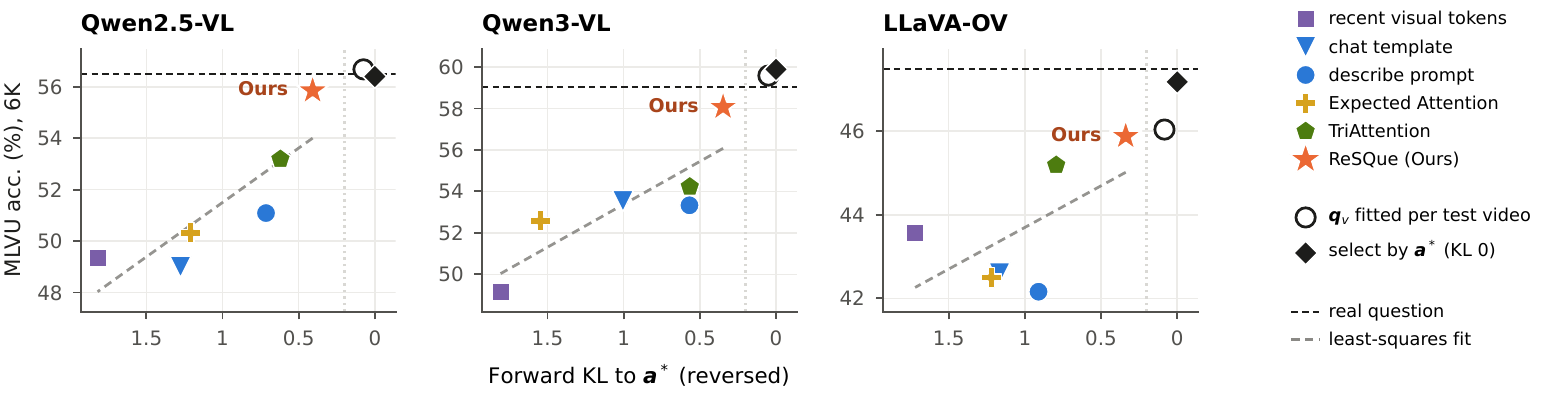
The attention induced by ReSQue is the closest to the question-averaged attention (lowest KL) on every backbone, and it is the most accurate of the deployable queries. Across queries, a lower KL goes with a higher accuracy (Spearman 0.94 on the Qwen models).

Reuse instead of recompute

Recomputing the query of a text prompt at every round brings no consistent gain over computing it once (−1.6 to +1.2 points). A learned soft token or scorer network adds overhead: ReSQue is 1.3–1.4× and 2.1–5.2× faster and 0.5–1.5 / 0.2–2.3 points more accurate.

Fitting beats averaging

TriAttention and Expected Attention estimate importance from query statistics. Fitting the queries to the attention itself yields substantially closer alignment, even when the same calibration questions are used.

Surrogate queries: closeness to the questions and accuracy
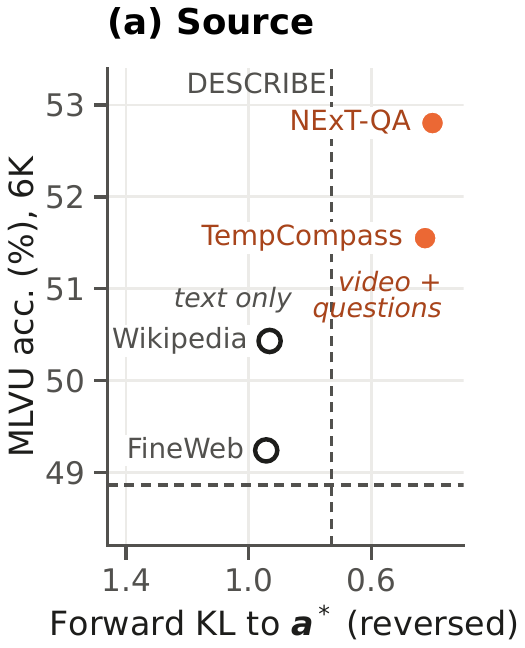
Surrogate queries: closeness to the questions and accuracy. Forward KL to the question-averaged attention (x, reversed) against MLVU accuracy at 6K (y). Dashed: the real question, unknown to the compressor. Right of the dotted line: oracles that use each video's own questions.

Calibration Data and Number of Vectors

Calibration source Calibration size Number of vectors per head
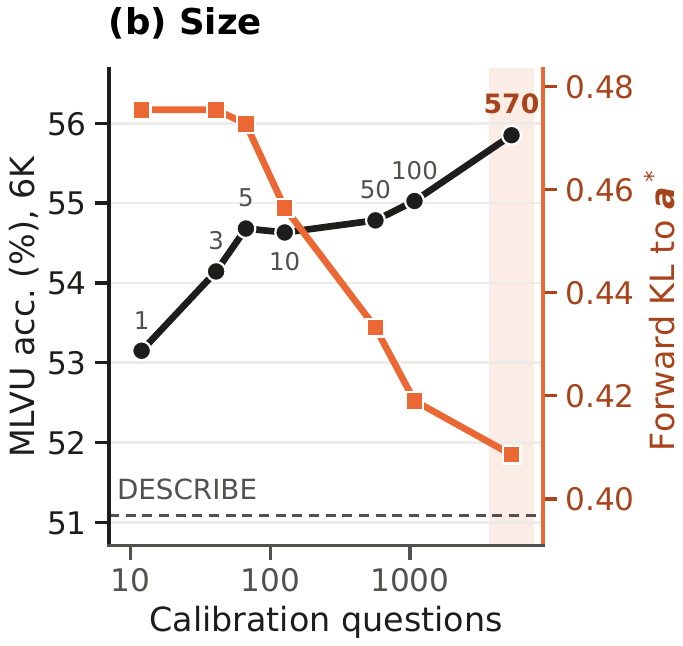
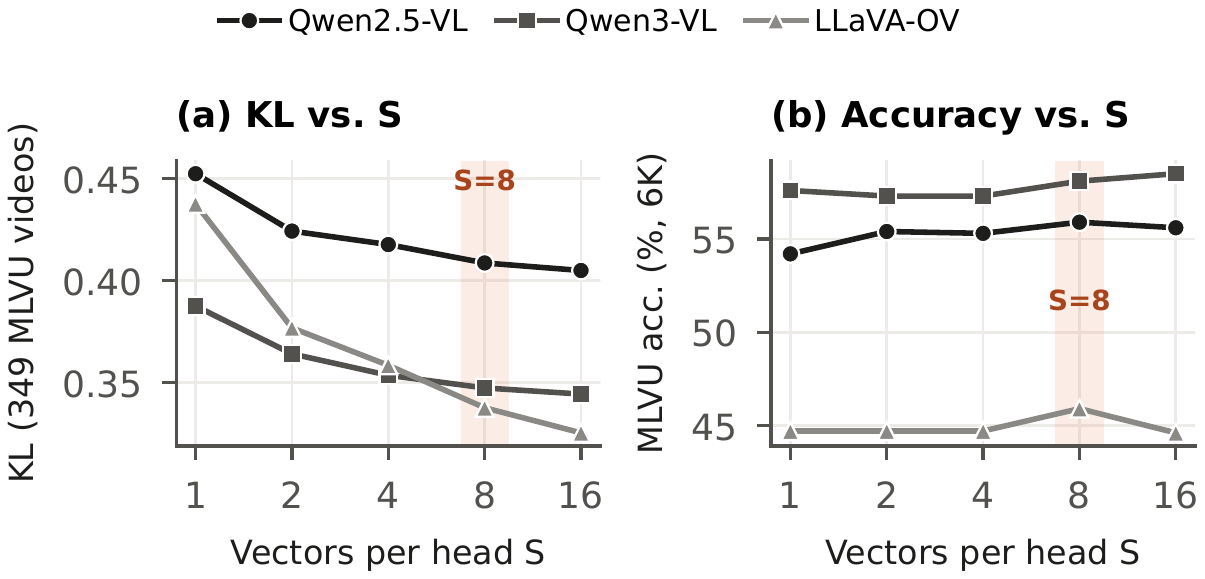
Calibration data and number of vectors. Left, source: ReSQue fitted on 100 samples of each source, averaged over the backbones; closer to the questions is to the right. Middle, size: fits on the first N NExT-QA videos on Qwen2.5-VL (N next to each point; N = 570 is the ReSQue of the main experiments). Right: number of query vectors per head S, KL on 349 MLVU videos and MLVU accuracy at 6K; ReSQue uses S = 8 (shaded). Dashed: DESCRIBE.

Calibration source

The calibration set pairs videos with questions, as the model meets them at inference. Both video sources (NExT-QA and TempCompass) are closer to the target attention than DESCRIBE (KL about 0.4 against 0.73) and more accurate, whereas the text corpora (FineWeb and Wikipedia) are farther from it than DESCRIBE and only slightly more accurate.

Calibration size

Ten NExT-QA videos already close 84% of the KL distance from DESCRIBE to the fit on all 570 videos. From 10 to 100 videos the accuracy stays nearly flat while the KL keeps falling slowly, and all 570 videos add 0.8 points: a small calibration set suffices.

Number of vectors

The KL decreases with every added vector on all three backbones and is nearly saturated by S = 8. The 8 vectors of a head do not collapse into one (mean pairwise cosine about 0.8, against 0.99 at the start), and S = 8 improves the accuracy over S = 1 on every backbone, while S = 16 is not consistently better.

BibTeX

@misc{choi2026resque,
  title  = {ReSQue: Representative Surrogate Query for Streaming Video KV Cache Compression},
  author = {Choi, Daehyeon and Youn, Sangwoo and Park, Chanho and Kim, Jaihoon and Lee, Phillip Y. and Lee, Byung-Kwan and Sung, Minhyuk},
  year   = {2026}
}